
What Happens If You Don't Adopt
Agencies without unified white-label platforms face:
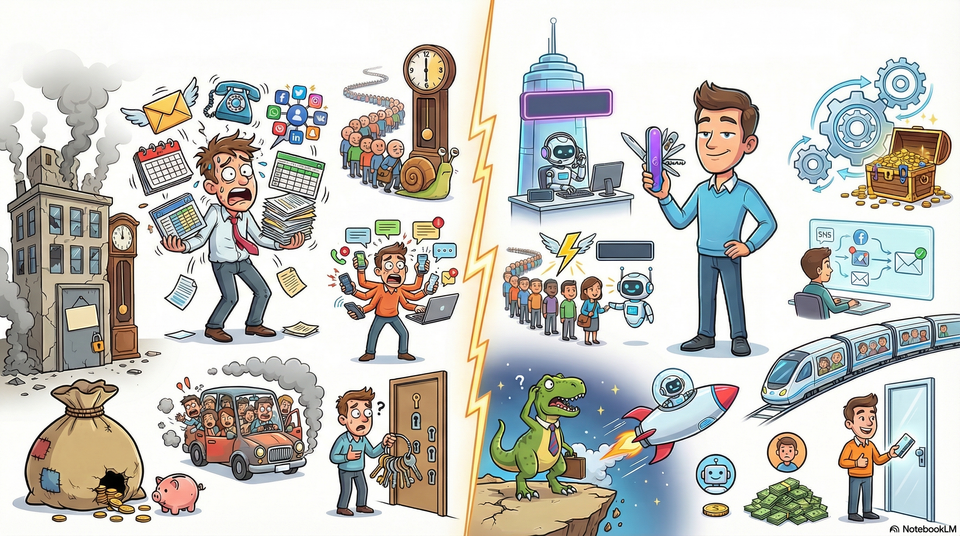
- Margin compression: Manual fulfillment costs stay fixed while AI-powered competitors reduce delivery costs by 40-60%. A competitor's Voice AI answers 100 calls monthly for $50 in platform costs. Your team handling the same volume costs $800+ in labor (assuming $20/hour agents, 2-3 minutes per call). That's a 16x cost difference that compounds monthly.
✅ HighLevel 30-Day Free Trial
- Capacity walls: Growth requires proportional hiring while competitors scale with existing teams. Your competitor adds 20 clients and deploys AI voice agents + chat automation. You add 20 clients and need to hire 2-3 more team members to handle calls, messages, and support.
- 24/7 service gap: Prospects calling at 8 PM, texting at 11 PM, or DMing on Instagram at 2 AM get instant AI responses from competitors. Your voicemail or "we'll respond tomorrow" message loses deals before morning arrives. In lead generation businesses, speed-to-contact within 5 minutes vs. 24 hours can mean 10x conversion rate difference.
- Multi-channel weakness: Clients receive inquiries across SMS, WhatsApp, Facebook, Instagram, Google Chat, and email. Competitors manage all channels in one unified inbox. You're juggling 6+ separate apps or asking clients to check multiple platforms. Missed messages = lost revenue for clients.
- Social lead delay: Competitors capture Facebook and TikTok leads instantly (native integration = immediate CRM entry + auto-nurture). You wait 15-30 minutes for Zapier connections, or worse, for manual exports. In fast-moving markets (real estate, automotive, urgent services), those 30 minutes mean competitors already booked the appointment.
- Client friction: Prospects compare your proposal, "We'll use your existing email tool, add an SMS service, integrate Calendly, set up Zapier, and manage your Facebook messages separately", against competitors' single-platform offer with Voice AI, unified messaging, and automated reputation management. Which sounds more professional and easier?
- Retention vulnerability: Clients experience the "grass is greener" effect as integrated platforms become the expected standard. When they see competitors' agencies offering 24/7 AI phone coverage, instant multi-channel response, and one-login convenience, your multi-tool stack feels outdated even if it technically works.
- AI capability gap: Voice AI, Conversation AI, Reviews AI, and Content AI are now baseline expectations in 2026, not premium features. Clients ask "Can your system answer our phone after hours?" and "Does your chat automatically qualify leads?" If the answer is no, you're eliminated before discussing pricing.
Timeline context:
Early adopters (2023-2024) have now refined their systems through thousands of client interactions. They've:
- Trained AI agents on hundreds of real conversations
- Built template libraries for instant client deployment
- Established positioning as "AI-powered agencies"
- Captured clients frustrated with traditional agencies
- Created case studies showing 24/7 coverage and faster response times
Late adopters (2026+) enter with no operational advantage, no AI expertise, no case studies, and less market credibility. You're not competing with agencies learning AI, you're competing with agencies that have mastered AI deployment at scale.
The mathematical reality: If early adopters serve clients at 50% lower fulfillment cost (AI vs. manual) while charging the same or higher prices, they either (a) undercut your pricing while maintaining margins, or (b) invest that margin difference into better sales/marketing. Either way, you lose deals.
The decision is not whether to adopt AI and automation. It's whether you lead the transition or follow it, and whether you enter the market with two years of learning deficit.
 Zoltan Juhasz